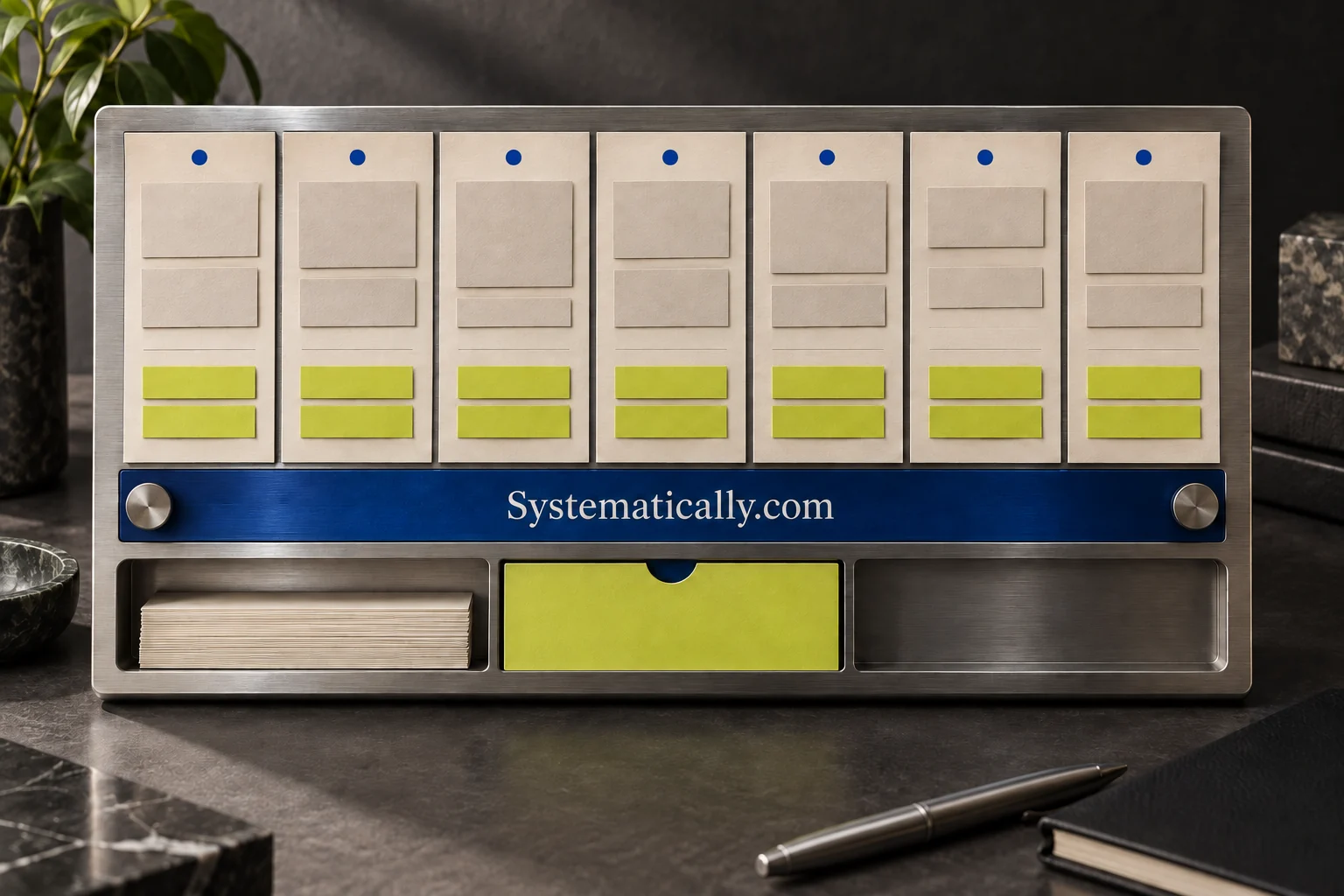
Concept note: this is an illustrative product direction for a future buyer of Systematically.com, not a live planning application.
Most task apps make it easy to add work. Fewer make it comfortable to admit that a week has limited space. A list can hold 200 intentions while Monday morning can hold only a few hours of focused attention, a meeting schedule, and whatever arrives without warning.
Systematically.com could become a weekly execution app built around that mismatch. Its job would be to help professionals choose a realistic set of commitments, connect recurring work to specific cues, and reset cleanly when the week changes.
The user and the first promise
The first user could be an independent professional, manager, or small-team operator who already has a calendar and task list but lacks a dependable weekly rhythm. The product would not ask that person to move every note, project, and message into a new universe on day one.
The initial promise could be simpler: bring the week’s priorities into one review, compare them with available capacity, and leave with a plan that is explicit enough to follow and flexible enough to repair.
That creates a product with a clear boundary. It is not another place to capture everything. It is the place where captured work becomes a weekly operating choice.
A five-part weekly loop
The core experience could follow five stages.
Collect. Pull forward unfinished commitments, recurring routines, calendar events, and a small number of candidate tasks from existing tools.
Check capacity. Show the fixed commitments and let the user reserve realistic blocks for focused work, administration, and buffer. The interface should make overcommitment visible before it becomes a Friday surprise.
Choose. Ask for a few outcomes that would make the week meaningfully complete. Supporting tasks can sit beneath those outcomes rather than competing as equal items in one long list.
Place cues. Connect the important actions to a time, place, preceding event, or clear trigger. “Prepare the forecast” becomes “After Tuesday’s pipeline meeting, update the forecast before opening the next meeting note.”
Review and reset. At the end of the week, close completed items, reschedule deliberately, drop work that no longer matters, and note one adjustment for the next cycle.
The app’s identity would come from that loop. Features would earn their place by helping one stage work better.
Use behavioral research with restraint
The idea of linking action to a cue has a useful research base. The National Cancer Institute’s overview of implementation intentions describes an if-then plan that connects a situation with a goal-directed response and specifies when, where, and how action will occur. A planning app can turn that concept into a simple prompt without pretending that one sentence guarantees behavior.
Habit research also argues against magical deadlines. A study by Lally and colleagues on habit formation in everyday settings found that automaticity increased with repetition in a consistent context, but the modeled time varied substantially among participants and behaviors. Missing one opportunity did not materially disrupt the modeled process. The study was limited in size and focused on simple health behaviors, so it should not be stretched into a universal claim about workplace productivity.
For Systematically.com, the practical lesson is modest: help users define a cue, repeat a manageable action, and recover without declaring the system broken after one missed day.
A worked week
Consider a product manager planning a week with nine meetings, a product brief, customer follow-ups, and a recurring metrics review.
During the capacity check, the app imports the meetings and shows that only three substantial focus blocks remain. The user chooses two weekly outcomes: circulate the product brief for comment and decide whether to advance one experiment. Customer follow-ups become a smaller batch scheduled after Wednesday’s interview block. The metrics review stays anchored to Friday morning.
The product brief is too large to treat as one task, so the user defines the next visible sequence: collect open questions, write the decision section, add supporting evidence, and request review. The cue for the first action is Monday’s team sync. The experiment decision depends on a data extract expected Thursday; if the extract is late, the task moves to an exception lane rather than appearing as a personal failure.
On Friday, the review shows that the brief went out, the experiment decision is waiting on data, and two follow-ups remain. The user reschedules the decision with its dependency attached, finishes one follow-up, drops the other because it is no longer useful, and reduces next week’s planned outcomes from three to two.
Nothing in that sequence is dramatic. That is the point. The product helps the user make better operating choices before, during, and after an ordinary week.
Product conventions worth keeping
Users already understand recurring tasks, calendar blocks, and review checklists. The product should respect those conventions rather than inventing new words for familiar behavior.
Todoist’s recurring-date documentation distinguishes a schedule anchored to the original date from one calculated after completion. That difference matters. “Every Friday” is a calendar commitment. “Seven days after completion” is a rolling interval. A weekly execution product should make the choice visible so a delayed routine does not silently rewrite the schedule.
Todoist also publishes an official weekly review template organized around before, during, and after stages, with a recurring reminder. That is evidence of a familiar product pattern, not proof that every person needs the same review. Systematically.com could make the loop configurable while keeping the structure easy to recognize.
What would make it different from a task manager
The app should resist winning on task count. Its useful data model would include outcomes, available capacity, recurring routines, cues, dependencies, and review decisions. A task can exist, but it should belong to a week for a reason.
The interface could show a “plan load” based on the user’s own time estimates and fixed commitments. It should label that figure as a planning aid, not a prediction. A user who consistently underestimates a certain class of work could see the pattern and adjust future plans without receiving a judgmental score.
Recovery deserves its own design. When a day disappears, the app could ask which commitments are still relevant, which are blocked, and which should be renegotiated. It should not celebrate endless rollover or shame the user with a growing overdue badge.
How early distribution could work
Early distribution could focus on independent consultants and small-team managers who publish or teach their own working methods. A weekly plan can be demonstrated in a short template, newsletter series, or live planning session without requiring access to a company’s internal systems.
An import from one calendar provider and one popular task tool would lower setup friction. The product could offer a free weekly review and charge for history, multiple workspaces, team rituals, or deeper integrations. Those are product hypotheses to test, not fixed business assumptions.
Partnerships with coaches, professional communities, and focused newsletters could work if the product lets each partner express a real method without turning the app into a marketplace of nearly identical templates. The best distribution artifact may simply be a clean, shareable weekly review that demonstrates the loop.
What execution would require
The first version should protect attention. It needs fast setup, accessible keyboard and mobile interactions, sensible calendar handling, and plain explanations of recurring dates. Notifications should be selective and controllable.
Privacy also matters because schedules and priorities can reveal sensitive work. The company would need clear permissions, narrow integrations, and retention choices that users can understand. A team version would need separate controls for private planning and shared commitments.
The product team should evaluate behavior without claiming that more daily use is always better. A successful weekly system may be opened briefly at the right moments and ignored while the person works.
The smallest useful next step
Prototype three screens before building a broad task database: the weekly review, the capacity check, and the reset. Give the prototype to people who already use a calendar and task manager. Watch where they hesitate, what they refuse to import, and whether the resulting plan survives a disrupted day.
If those users return for a second weekly review because the loop helped them make decisions, the concept has earned its next layer. Systematically.com would give it a name built for that repeated practice.